
UKRAINIAN DICTION RESOURCES
Discover Ukraine’s Hidden Vocal Repertoire Gems

UNDERREPRESENTED HERITAGE
Despite Ukraine’s rich musical lineage, Ukrainian classical works remain largely unknown on the global stage. Major orchestras and opera houses rarely include these compositions in their programming.
HISTORICAL SUPPRESSION
Under Tsarist and later Soviet regimes, Ukrainian cultural expression was systematically oppressed. Many Ukrainian composers were overshadowed, their works labeled as “Russian,” or they were simply never given the chance to reach an international audience.
CULTURAL APPROPRIATION
During centuries of tragic colonial history under different political regimes, Ukraine has suffered not only cultural appropriation but also bans on the use of the Ukrainian language, the destruction of cultural objects, and the persecution and physical elimination of Ukrainian artists, intellectuals and cultural figures.
Even today, several pieces rooted in Ukrainian musical tradition are popularly presented as Russian repertoire, further erasing Ukraine’s artistic identity.
SCARCE PERFORMANCES
Statistics show Ukrainian operas and vocal pieces make up only a fraction of global performances compared to more frequently staged Western or Russian works.
Ukrainian classical music is a treasure trove of lyrical beauty, distinctive cultural heritage, and undeniable global significance, yet many of its composers remain severely underrepresented on the world’s concert and operatic stages.
At UCVP, we are deeply committed to the decolonization of Ukrainian classical vocal repertoire. For centuries, Ukrainian musical culture developed under conditions of imperial domination, censorship, political repression, and repeated restrictions on the public use and publication of the Ukrainian language. Despite these forces, Ukrainian composers and artists continued to create and preserve a distinctive musical tradition rooted in their language, poetry, history, folklore, and national consciousness.
The consequences extend far beyond the periods in which these restrictions were imposed. Ukrainian composers, repertoire, and national identity have been marginalized by the ways classical music history has been constructed, taught, published, and performed. Ukrainian works and cultural materials have at times been appropriated, absorbed into Russian imperial and Soviet narratives, or presented internationally without adequate recognition of their origins. As a result, generations of musicians outside Ukraine have encountered an incomplete picture of Eastern European and Slavic music, one in which Ukrainian contributions have too often been obscured, misidentified, or attributed to others.
UCVP seeks to help correct that imbalance. Through research, performance, education, and accessible language and repertoire resources, we work to return Ukrainian composers and their music to their rightful place within musicological scholarship, vocal literature, and international performance practice. Decolonization, for us, means not only recovering neglected works, but also reclaiming their language, cultural context, historical provenance, and artistic identity.
In this section, we spotlight composers whose music reveals the remarkable breadth of Ukraine’s vocal heritage, from the sacred and secular works of the eighteenth century to Romantic art song, opera, modernism, and contemporary composition.
From the Baroque and Classical achievements of Maksym Berezovsky, Dmytro Bortnyansky, and Artem Vedel, to the emergence of a distinctly Ukrainian national school in the nineteenth century through figures such as Mykola Lysenko, Semen Hulak-Artemovsky, Mykola Arkas, Vladyslav Zaremba, Anatol Vakhnianyn, Ostap Nyzhankivsky, Denys Sichynsky, and Hryhory Alchevsky, the development of Ukrainian vocal music reflects a complex relationship among artistic expression, language, folklore, and national consciousness.
The generations that followed carried this legacy in strikingly different directions. Kyrylo Stetsenko, Mykola Leontovych, Yakiv Stepovyj, Oleksandr Koshyts, Stanyslav Lyudkevych, Vasyl Barvinsky, Viktor Kosenko, Levko Revutsky, and Borys Lyatoshynsky drew upon Ukrainian poetry, folk and sacred traditions, European Romanticism, modernism, and evolving harmonic languages to create music of striking individuality.
Throughout the twentieth and twenty-first centuries, composers including Mykhailo Verykivsky, Yuliy Meitus, Heorhij Maiboroda, Mykola Dremlyuha, Vitaliy Kyreiko, Anatoly Kos-Anatolsky, Oleksandr Bilash, Ihor Shamo, Ihor Sonevytsky, Myroslav Skoryk, Valentyn Silvestrov, and others continued to expand the expressive possibilities of the Ukrainian singing voice, producing a vast body of music that remains largely unfamiliar to performers and audiences outside Ukraine.
Women have also played a vital role in shaping this legacy. Lyudmyla Oleksandrova, Stefania Turkewich, Lesya Dychko, Hanna Havrylets, and other Ukrainian women composers brought distinctive perspectives to the classical canon, even as their contributions were too often overlooked.
These are only a few of the compelling voices you will encounter through the Ukrainian Classical Voice Project. Ukraine’s classical vocal heritage extends far beyond the names commonly represented in Western music history, and our continuing work seeks to bring its scope and diversity into greater visibility through scholarship, education, performance, and practical resources for singers.
How many of these names have you encountered before?
We invite you to discover the fascinating world of Ukrainian opera and art song, and perhaps to find music that will become part of your own artistic journey.
UCVP is developing diction and repertoire resources designed to help professional singers, voice teachers, coaches, and students approach this music with linguistic accuracy, cultural understanding, and dramatic authenticity. Our materials include IPA transcriptions, phonetic transliterations, pronunciation guidance, translations, scores, and information about the poetic, historical, cultural, and dramatic context of individual works.
Language is especially significant to this work. Because Ukrainian itself was repeatedly subjected to restrictions and suppression, performing this repertoire in its original language is not merely a matter of accurate diction. It restores an essential element of the music’s identity and allows the relationship between text, sound, poetry, and musical expression to be heard as its composers intended.
Begin with our sample materials for Mavka’s Aria from The Forest Song, the lyrical fairy-tale opera by Vitaliy Kyreiko. The aria and accompanying resources are available for free download in the original Ukrainian.
By studying and performing this repertoire, singers can do more than expand their own artistic horizons. They can help return important works and their creators to the international vocal canon, allowing Ukrainian musical voices that have too often remained unheard beyond their homeland to reach new performers and audiences.
Enjoy discovering the music, language, poetry, and spirit of Ukrainian classical song.
Your next signature aria or art song may be waiting within the overlooked pages of Ukraine’s musical history.
Stay tuned. More diction and repertoire resources are coming soon!
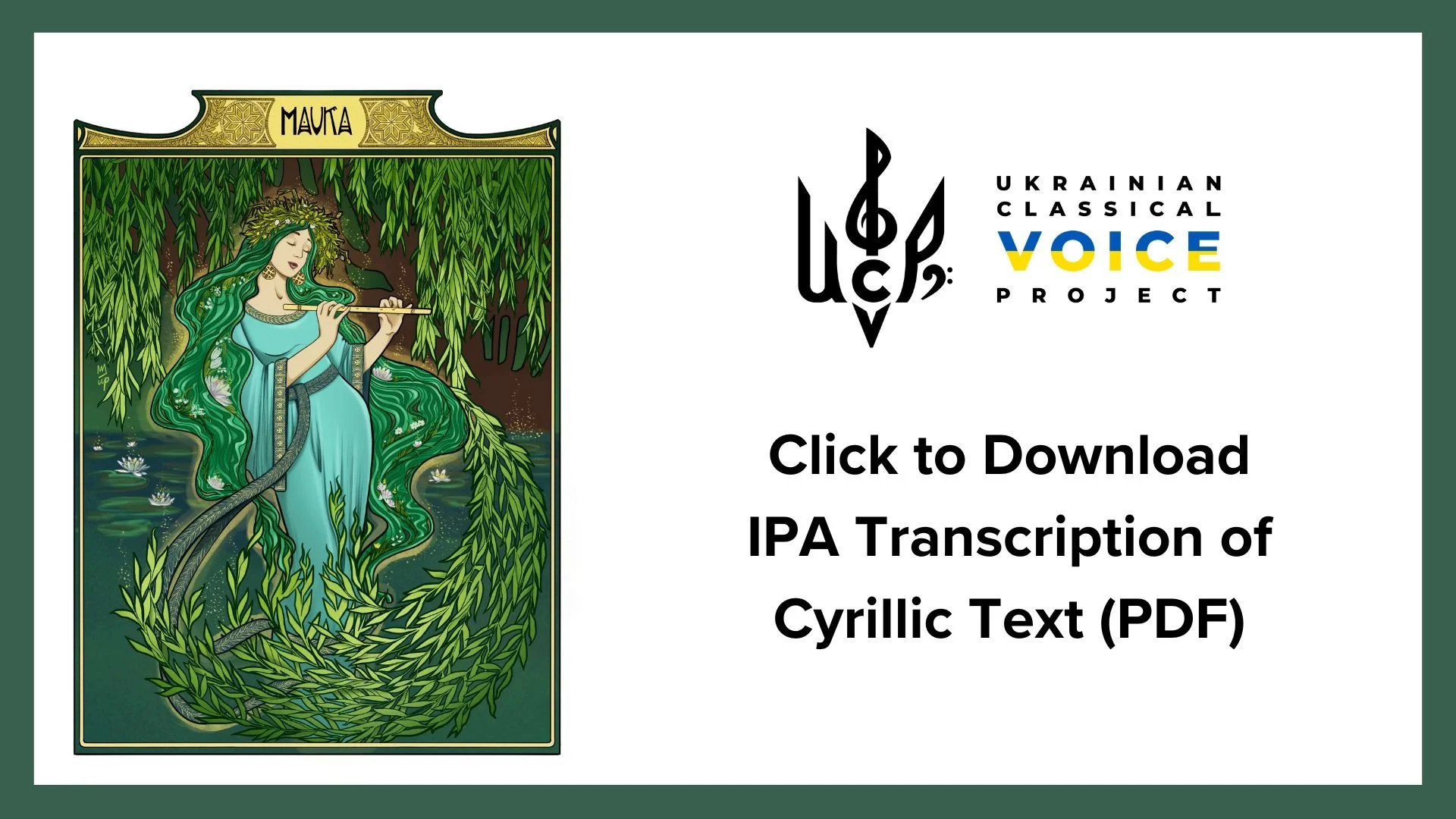
IPA TRANSCRIPTION OF CYRILLIC TEXT
Mavka’s aria from “The Forest Song” by V.Kyreiko (download the PDF file)
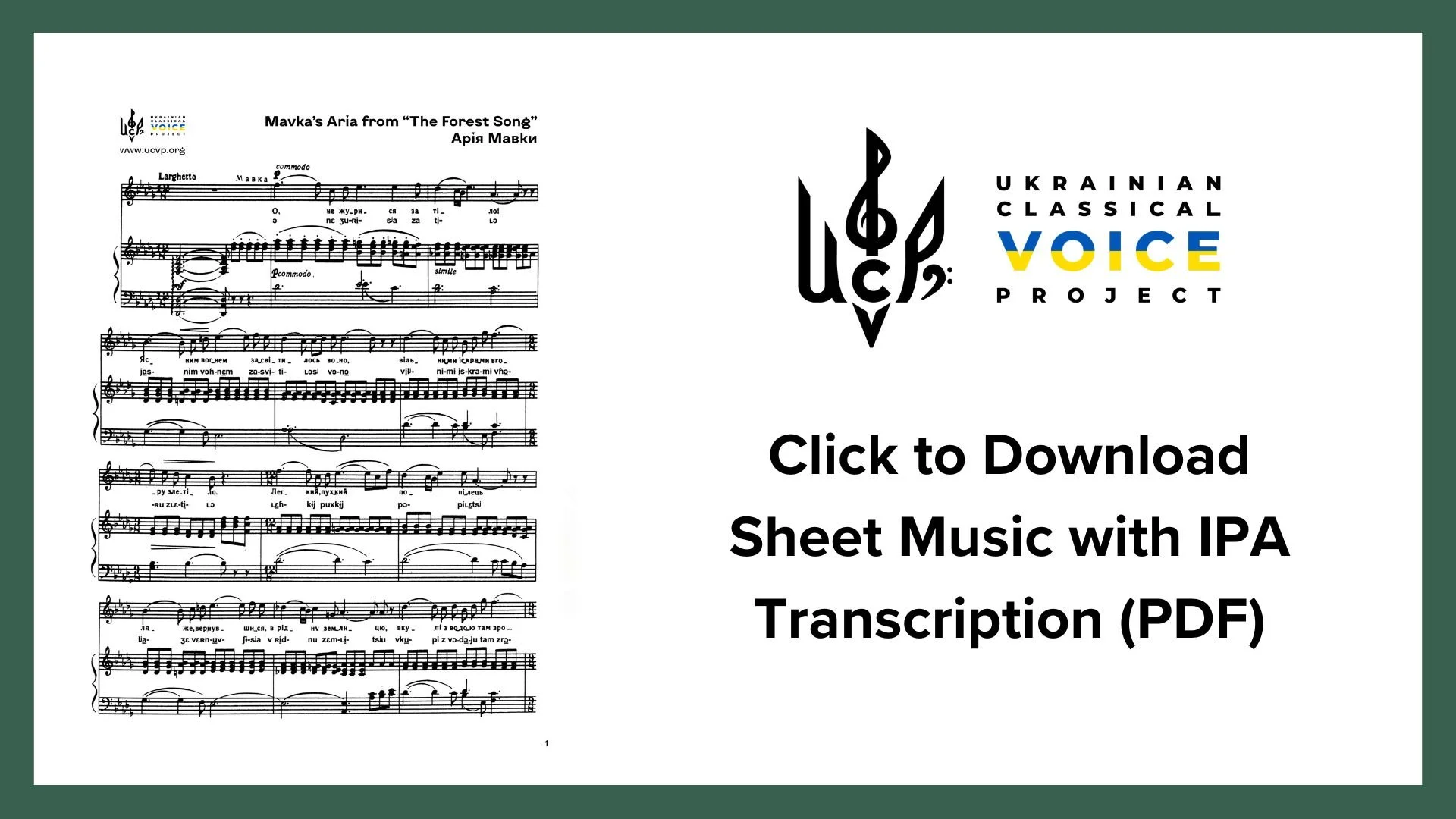
SHEET MUSIC WITH IPA TRANSCRIPTION
Mavka’s aria from “The Forest Song” by V.Kyreiko (download the PDF file)
DRAMATIC SCENE CONTEXT
Mavka’s aria from “The Forest Song” by V.Kyreiko (download the PDF file)
Download Sample Materials
🎵
Download Sample Materials 🎵
This video walks you through the Ukrainian Alphabet in order, alongside the IPA ( International Phonetic Alphabet ) symbols for each letter.
You’ll notice that many consonants can present as both soft (palatalized) and hard (non-palatalized) versions. Mastering these subtle differences is key to sounding like a native speaker!
Some of our favorite Ukrainian letters include Ґ, І, Ї, and Є—watch the video to learn exactly how they are pronounced. Have fun exploring these beautiful sounds of the distinct and melodic Ukrainian language!

Support Ukrainian musical heritage by including a Ukrainian aria in your next audition, or a Ukrainian art song in an upcoming recital!
Elevate your performance by booking a personalized one-on-one diction coaching with Irina Petrik, founder of UCVP
Introducing the Anthology of Ukrainian Arias
The Ukrainian Classical Voice Project is pleased to announce the forthcoming Anthology of Ukrainian Arias, Soprano Edition, developed in collaboration with Glendower Jones of Classical Vocal Reprints. The anthology features music editing by Ukrainian composer Maxim Kolomiiets, score engraving by Dr. Matthew Herman, and original illustrations by Ukrainian artist Ula Patoka.
Conceived and compiled by UCVP founder Irina Petrik, DMA candidate in Voice Performance at Shenandoah Conservatory, the anthology brings together Ukrainian operatic repertoire with original diction resources, English translations, composer biographies, and historical and dramatic context designed to support informed performance and study.
Created to expand access to Ukrainian opera for singers, voice teachers, coaches, and scholars, the anthology presents works by composers whose music remains significantly underrepresented in international performance and vocal scholarship.
Organized by voice type, with separate volumes for soprano, tenor, baritone, and bass, the anthology is designed as both a performance resource and an introduction to the broader historical, linguistic, and dramatic context of Ukrainian opera.
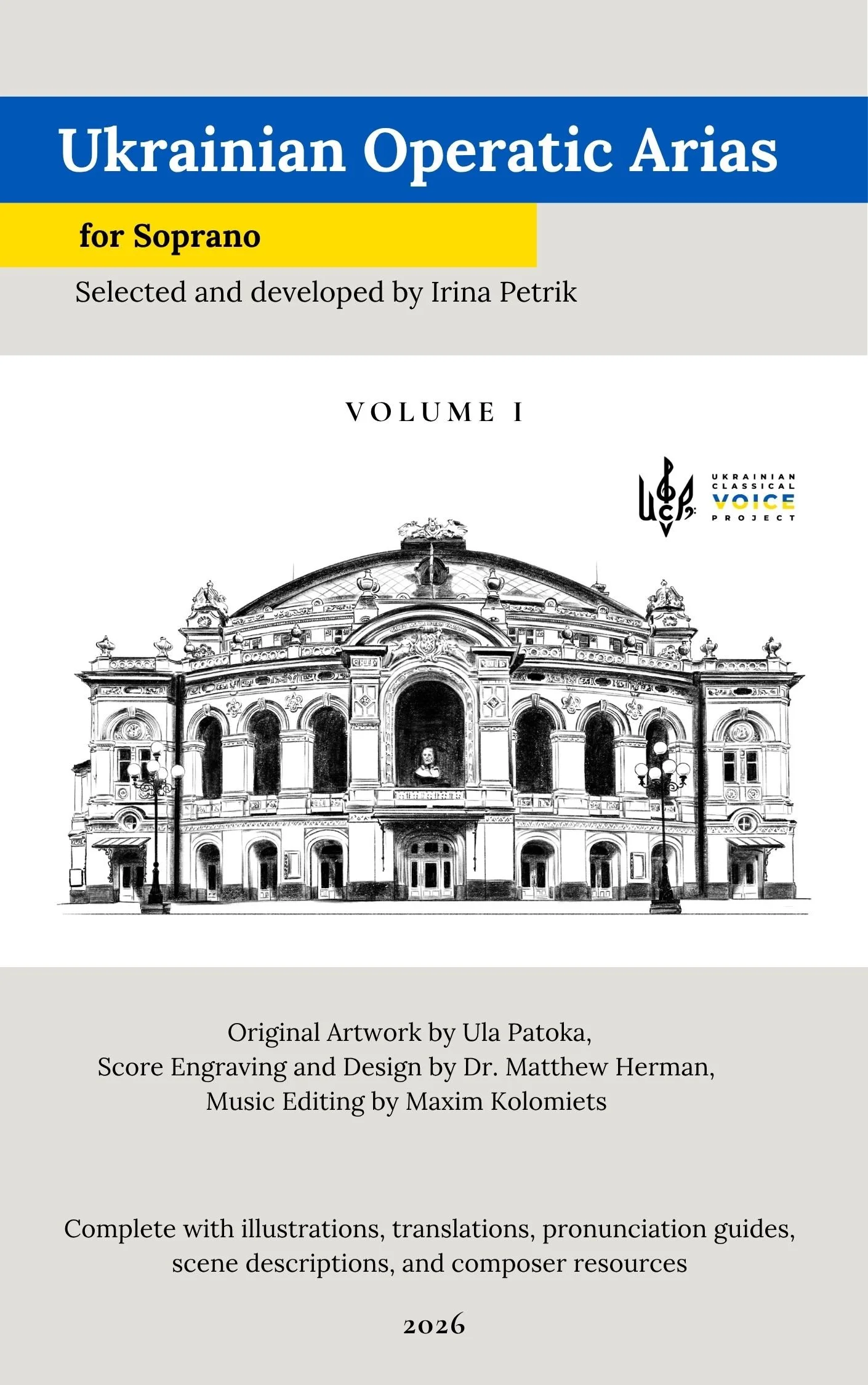
Each volume will include:
Complete musical scores
International Phonetic Alphabet (IPA) transcriptions
English translations
Scene descriptions and opera synopses
Composer biographies and historical context
Original illustrations
By bringing the music, language, dramatic context, and history of these works together in one accessible resource, the Anthology of Ukrainian Arias seeks to support informed performance while introducing a wider international community of singers and educators to the remarkable richness of Ukraine’s operatic heritage.
Read more about the artistic collaboration and illustrations in Ula Patoka’s blog post.

WHY IT MATTERS
FILLING A GAP
Ukrainian operatic repertoire remains underrepresented, with few reliable resources offering accurate translations, IPA transcriptions, and contextual notes.
UNIQUE RESOURCE
By compiling and standardizing this information, we empower vocalists, educators, and researchers worldwide to explore Ukraine’s rich musical heritage.
SUPPORTING UCVP’S MISSION
The anthology series furthers our goal of preserving and promoting Ukrainian classical music on the global stage.
GLOBAL DEMAND
No comprehensive publication of Ukrainian arias currently exists in the English language.
HIGH-QUALITY CONTENT
Expertly researched transcriptions, translations, and historical insights.
Original illustrations by our in-house artist, adding a distinctive aesthetic to the collection.
IMPACTFUL COLLABORATION
Aligned with UCVP’s mission to spotlight a vital but overlooked segment of classical music.